

IMEMR
EMRO
Volume 7, Issue 2 (2026)
3 2026, 7(2): 81-87 |
Back to browse issues page
Request Type:



History
Received: 2026/02/20 | Accepted: 2026/04/29 | Published: 2026/05/8
Received: 2026/02/20 | Accepted: 2026/04/29 | Published: 2026/05/8
How to cite this article
Ghazi Sadi S, Suleiman Hassan A, Alinejad-Naeini M, Khaleghi Y, Sabeti F. Parenting Stress and Quality of Life among Mothers of Children with Asthma in Iraq. 3 2026; 7 (2) :81-87
URL: http://jccs.daneshafarand.org/article-8-87227-en.html
URL: http://jccs.daneshafarand.org/article-8-87227-en.html
Download citation:
BibTeX | RIS | EndNote | Medlars | ProCite | Reference Manager | RefWorks
Send citation to:


Rights and permissions
BibTeX | RIS | EndNote | Medlars | ProCite | Reference Manager | RefWorks
Send citation to:


1- Department of Pediatric Nursing, Faculty of Nursing and Midwifery, Iran University of Medical Sciences, Tehran, Iran
2- Department of Psychology, College of Education for Humanities, Diyala University, Diyala, Iraq
3- Department of Pediatric and Neonatal Intensive Care Nursing, Faculty of Nursing and Midwifery, Iran University of Medical Sciences, Tehran, Iran
4- “Nursing and Midwifery Research Center, Health Management Institute” and “Department of Pediatric and Neonatal Intensive Care Nursing, Faculty of Nursing and Midwifery”, Iran University of Medical Sciences, Tehran, Iran
Keywords:
| Abstract (HTML) (181 Views)
Full-Text: (9 Views)
Introduction
Asthma is one of the most common chronic respiratory diseases in children and remains an important public health concern worldwide [1-3]. Caring for a child with asthma may be associated with increased caregiver burden, psychological distress, and reduced quality of life (QoL), particularly when asthma is severe or poorly controlled [4-6]. Higher parenting stress has also been associated with poorer QoL among caregivers of children with chronic conditions [4, 7]. However, the strength and nature of these associations differ according to cultural, socioeconomic, and healthcare contexts.
Understanding caregiver psychological health is particularly important in Middle Eastern countries, where caregiving experiences are strongly influenced by sociocultural norms, family structures, and the availability of healthcare and social support services. Iraq represents a unique context in this regard. Decades of armed conflict, political instability, and economic challenges have substantially affected the country’s healthcare infrastructure and the accessibility of healthcare services, creating additional burdens for families caring for children with chronic illnesses [8]. Childhood asthma also remains a significant public health concern in Iraq and across the Eastern Mediterranean Region, where relatively high prevalence rates have been reported and environmental factors, including dust storms and air pollution, contribute substantially to respiratory morbidity [9]. In this setting, mothers typically assume primary responsibility for daily asthma management, and cultural expectations regarding parental roles may further intensify caregiving responsibilities and their associated psychological burden [10].
However, evidence concerning parenting stress and caregiver QoL among Iraqi mothers of children with asthma remains limited. Most existing evidence has been generated in Western or East Asian populations, and relatively few studies have examined parenting stress and caregiver QoL simultaneously while considering demographic and clinical characteristics. This study aimed to examine parenting stress, QoL, and their relationship among mothers of children with asthma in Iraq. It also investigated demographic and clinical factors associated with parenting stress and QoL.
Instrument and Methods
Design and sample
This cross-sectional study was conducted among mothers of children with asthma in Baquba, Iraq, at Baquba Teaching Hospital and Al-Batoul Teaching Hospital, which provide pediatric services to children from both urban and rural areas. A minimum sample size of 250 participants was calculated using Cochran’s formula, with a 95% confidence level and a 5% margin of error. Participants were recruited using convenience sampling during routine clinic visits.
Mothers were eligible if they had no other child with a chronic disease and their child had another major chronic disease or disability in addition to asthma; they were the primary caregivers of children aged 5–15 years who had physician-diagnosed asthma for at least 6 months and were receiving care at one of the study hospitals. Mothers were also required to be directly involved in their child’s daily asthma care, have no visual, hearing, or cognitive impairment that could interfere with questionnaire completion, and provide written informed consent. Mothers were excluded if they declined to participate or returned incomplete questionnaires.
Instrument
A structured questionnaire was developed to collect demographic and clinical information related to both parents and their children. Maternal parameters included age, educational level, and marital status. Paternal parameters included age and educational level. Child-related parameters included age, sex, age at asthma diagnosis, birth order, and asthma severity. Asthma severity was classified as mild, moderate, or severe according to the Global Initiative for Asthma (2025) guidelines [11].
The Pediatric Asthma Caregiver’s Quality of Life Questionnaire (PACQLQ), developed by Juniper et al. [12], was used to assess caregiver QoL. The 13-item instrument comprises emotional function (9 items) and activity limitation (4 items), with responses scored on a 7-point Likert scale. Higher scores indicate better QoL. The Arabic version validated by Shaikhan & Makhlouf was used and demonstrated good internal consistency in the present study (Cronbach’s α=0.87) [13].
Parenting stress was measured using the Parental Stress Scale (PSS), developed by Berry & Jones [14]. The psychometric properties of this scale have also been examined among families of children with chronic health conditions [15]. The scale consists of 18 items rated on a 5-point Likert scale ranging from strongly disagree to strongly agree. Total scores range from 18 to 90, with higher scores indicating greater parenting stress. The instrument was translated into Arabic using a forward–backward translation procedure. The translated version was reviewed by a panel of experts to establish content validity and ensure cultural appropriateness. The present adaptation followed established cross-cultural guidelines, and the strong internal consistency observed (Cronbach’s α=0.90) supports its reliability in this sample.
Procedure
Data were collected between February and October 2024 using convenience sampling. The researcher visited the pediatric wards of Baquba Teaching Hospital and Al-Batoul Teaching Hospital during both morning and afternoon shifts on different days of the week to recruit eligible participants. Before data collection, the researcher introduced herself, explained the study’s purpose and procedures, and obtained written informed consent from all participants. The mothers were assured that participation was voluntary, that all questionnaires were anonymous, and that the findings would be reported in aggregate form without revealing any personal identifiers. Participants completed the questionnaires at a time convenient for them, which required approximately 15–20 minutes. The researcher remained available throughout the process to answer participants’ questions and reviewed each completed questionnaire to ensure that no items were left unanswered. For mothers who were unable to read or write, the researcher read each question aloud, recordedAS their responses, and completed the questionnaires on their behalf.
Data analysis
Data were analyzed using SPSS 26. Independent-samples t-tests and one-way analysis of variance were used to compare QoL and parenting stress across demographic and clinical characteristics. Pearson’s correlation was used to assess the association between parenting stress and QoL. Two multiple linear regression models were constructed to identify predictors of QoL and parenting stress. Parameters significantly associated with the outcomes in bivariate analyses (p<0.05) were entered into the corresponding regression models.
Findings
The mean age of the mothers was 32.00±6.41 years, whereas the mean age of the fathers was 37.13±7.74 years. Slightly more than half of the children were boys (52.4%), and the mean age of the children was 9.8±3.4 years. The mean age at asthma diagnosis was 6.81±3.01 years.
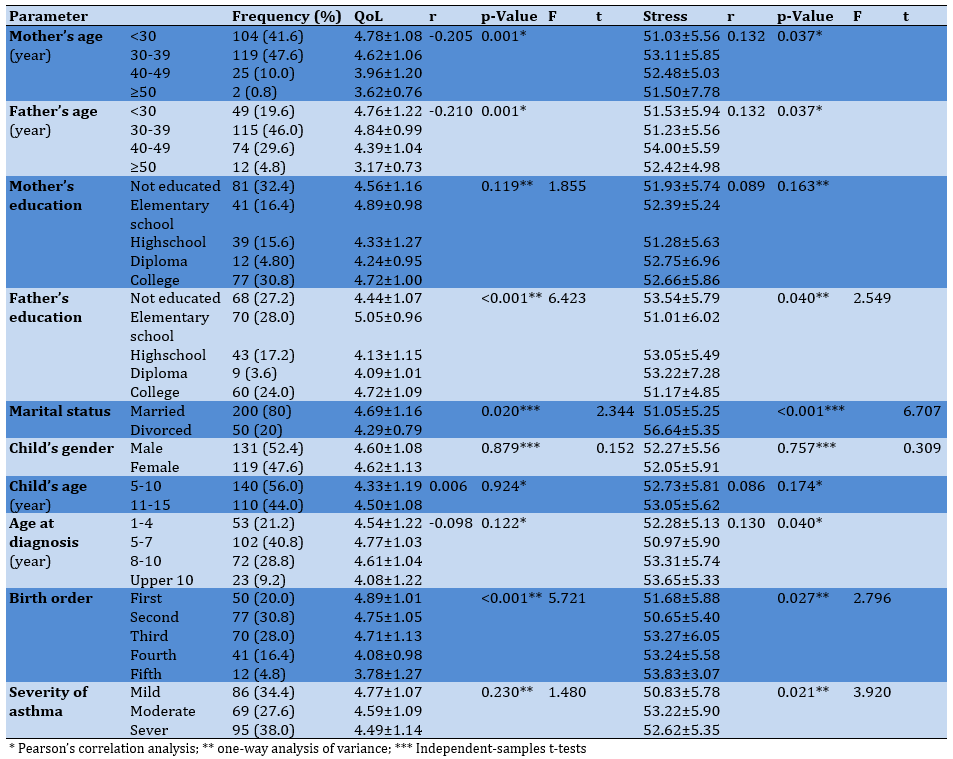
Parenting stress was significantly associated with mothers’ age (p=0.037), fathers’ age (p=0.037), fathers’ educational level (p=0.040), marital status (p<0.001), age at asthma diagnosis (p=0.040), birth order (p=0.027), and asthma severity (p=0.021). No significant associations were observed between parenting stress and mothers’ educational level, the child’s sex, or the child’s age (p>0.05; Table 1).
Table 1. Relationship between demographic characteristics and quality of life (QoL) and stress among mothers of children with asthma
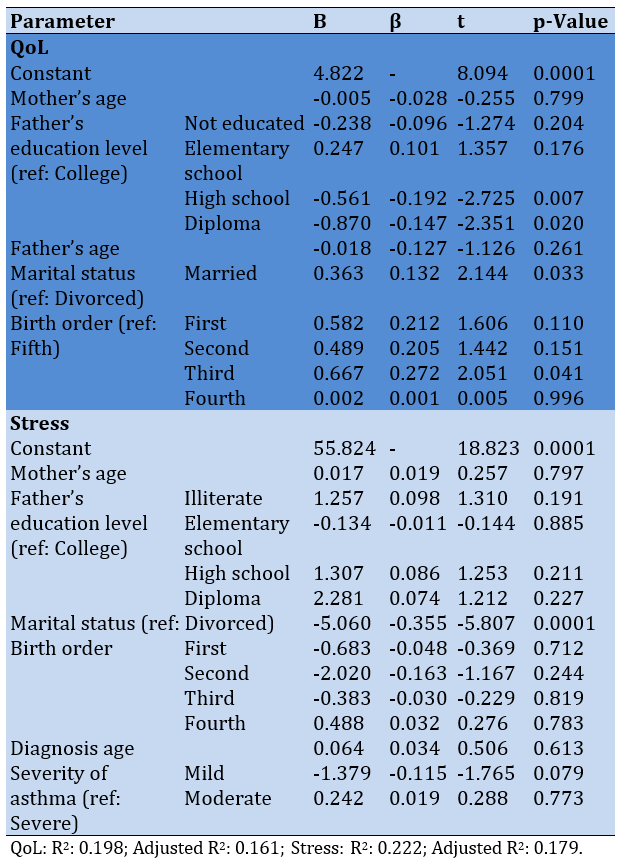
The overall model explained 19.8% of the variance in QoL (R²=0.198, adjusted R²=0.161). Mothers’ age and fathers’ age were not associated with QoL after adjustment.
Fathers’ educational level, birth order, age at diagnosis, asthma severity, and maternal age were not associated with parenting stress in the final model (Table 2).
Table 2. Linear regression analysis of the effects of demographic characteristics on quality of life (QoL) and stress among mothers of children with asthma
The mean score for the emotional function domain of QoL was 4.68±1.16, whereas the mean score for activity limitation was 4.43±1.16. The mean overall QoL score was 4.61±1.10, indicating a moderate level of QoL based on the PACQLQ scoring system. The mean parenting stress score among mothers was 52.16±5.71, suggesting a relatively elevated level of parenting stress. Pearson correlation analysis demonstrated significant negative correlations between parenting stress and all QoL measures. Parenting stress was negatively correlated with emotional functioning (r=−0.311, p<0.001) and activity limitation (r=−0.366, p<0.001).
Similarly, a significant inverse relationship was observed between parenting stress and overall QoL (r=−0.346, p<0.001). These findings indicate that higher levels of parenting stress were associated with poorer QoL among mothers of children with asthma.
Discussion
This study examined parenting stress and QoL among mothers of children with asthma in Iraq. The findings showed moderate parenting stress and moderate impairment in maternal QoL, with a significant inverse association between parenting stress and QoL. In the multivariable analyses, marital status, paternal educational level, and birth order were significant predictors of maternal QoL, whereas marital status was the only significant predictor of parenting stress.
Mothers reported moderate impairment in QoL, with activity limitations being more pronounced than emotional impairment. This finding is consistent with previous studies showing reduced caregiver QoL among parents of children with asthma [5, 12]. The demands of continuous asthma management, including symptom monitoring, medication administration, healthcare visits, and concerns about disease control, may contribute to limitations in caregivers’ daily activities and emotional well-being [5]. Similarly, mothers reported moderate levels of parenting stress, consistent with previous evidence that caring for a child with asthma can impose a considerable psychological burden on caregivers [4, 5]. Anxiety, fear, guilt, disruption of family routines, and uncertainty about exacerbations may further increase caregiver distress [16, 17]. However, Zaidman et al. [18] report relatively low parenting stress among caregivers of children with asthma, suggesting that disease characteristics, cultural expectations, coping strategies, and available social support may influence caregivers’ stress responses.
There was a significant inverse relationship between parenting stress and maternal QoL. Mothers experiencing greater parenting stress reported poorer overall QoL and emotional functioning, as well as greater activity limitations. This finding is consistent with research among caregivers of children with asthma and other chronic conditions, which has demonstrated that greater caregiving stress is associated with poorer caregiver QoL [4, 7]. Persistent caregiving demands may deplete emotional resources, restrict participation in daily and social activities, and make it more difficult for caregivers to cope with the ongoing requirements of disease management. The observed association highlights the importance of considering caregivers’ psychological well-being alongside the child’s clinical management.
Maternal age and paternal age were associated with QoL and parenting stress in the bivariate analyses, but these associations did not remain significant after adjustment. Older maternal age was associated with poorer QoL, which may reflect the cumulative demands of caregiving and other family responsibilities. However, this finding differs from those of studies that did not identify maternal age as a significant determinant of caregiver QoL [4, 13]. Differences in study populations, healthcare systems, and sociocultural contexts may partly explain these findings. The loss of significance for paternal age in the multivariable models suggests that its bivariate association may have reflected other family characteristics.
Maternal educational level was not significantly associated with QoL or parenting stress. This may indicate that formal education alone does not adequately capture caregivers’ ability to manage childhood asthma. Previous research suggests that health literacy and disease-management knowledge may be more relevant than educational attainment alone. Lower parental health literacy has been associated with poorer disease-related knowledge and less effective management of chronic conditions in children [19], whereas higher electronic health literacy has been associated with greater confidence in disease management among parents of children with chronic diseases [20]. In contrast, paternal educational level was a significant predictor of maternal QoL. Mothers whose husbands had lower educational attainment reported poorer QoL than those whose husbands had a college education. Fathers’ asthma knowledge, involvement, and management skills may contribute to family asthma management and parental QoL [10]. Nevertheless, because paternal involvement and asthma knowledge were not directly measured in the present study, this interpretation should be considered cautiously.
Birth order was also a significant predictor of maternal QoL. Mothers of third-born children reported better QoL than mothers of fifth-born children. Evidence specifically addressing birth order in childhood asthma is limited; however, previous research has suggested that larger family size may be associated with poorer caregiver QoL because of greater caregiving responsibilities, financial demands, and competition for parental attention [21]. The relatively small number of mothers of fifth-born children in the present sample also warrants caution when interpreting this finding.
Marital status was significantly associated with both maternal QoL and parenting stress and remained an independent predictor in both multivariable models. Married mothers reported better QoL and lower parenting stress than divorced mothers. This finding is consistent with studies suggesting that partner and family support may reduce caregiver burden and improve psychosocial well-being [22, 23].
The availability of practical and emotional support may help mothers manage the demands of childhood asthma, whereas the absence of a partner may increase caregiving responsibilities. However, social support and family functioning were not directly assessed in this study; therefore, the mechanisms underlying this association cannot be established.
Asthma severity and age at diagnosis were associated with parenting stress in the bivariate analyses but were not independent predictors in the final regression model. Mothers of children with moderate or severe asthma reported higher stress than those caring for children with mild asthma, which is consistent with previous research linking greater asthma severity to increased caregiver burden [6, 24]. More severe asthma may require closer symptom monitoring, more intensive treatment, and greater healthcare utilization, potentially increasing caregivers’ concerns about disease control [17]. The loss of significance after adjustment suggests that family and demographic characteristics may account for part of this association. Similarly, the association between age at diagnosis and parenting stress did not remain significant after adjustment. Although the diagnostic period may involve uncertainty and anxiety for families, the present cross-sectional findings do not establish an independent effect of age at diagnosis on parenting stress [24, 25].
Overall, these findings support a family-centered approach to childhood asthma management. Assessing caregiver stress and QoL may help healthcare professionals identify mothers experiencing substantial psychosocial burden. Interventions that provide asthma-management education, strengthen coping skills, and connect families with appropriate psychosocial support may be particularly relevant for mothers with limited family support. Future longitudinal and multicenter studies should examine whether changes in asthma control, family support, and caregiver stress are associated with subsequent changes in caregiver QoL.
This study has several notable strengths. First, it examined parenting stress and QoL among mothers of children with asthma at two major teaching hospitals in Baquba, Iraq, using a relatively large sample of 250 mothers, which enhanced the robustness of the findings. Second, the use of well-established and psychometrically sound instruments, the PACQLQ and PSS, strengthened the reliability and validity of the measurements. Third, by focusing on both QoL and parenting stress simultaneously, this study provides a broader perspective on the psychosocial challenges experienced by mothers caring for children with asthma and offers evidence that may inform family-centered healthcare interventions. Finally, the use of multivariable regression analyses enabled the identification of demographic predictors of parenting stress and QoL, thereby extending previous research that has primarily focused on bivariate associations.
Several limitations should also be acknowledged. First, the cross-sectional design precludes conclusions about causality between parenting stress and QoL. Although significant correlations were identified, the direction of these relationships cannot be determined. Second, we did not assess all parameters that may influence parenting stress and QoL, such as social support, household income, and access to healthcare services, which may have confounded the observed correlations. Third, we relied on self-reported questionnaires, which may be subject to recall and social desirability biases.
Conclusion
Parenting stress, maternal marital status, paternal education, and child birth order significantly predict the quality of life of Iraqi mothers of children with asthma.
Acknowledgments: The authors would like to express their sincere gratitude to the Vice-Chancellery for International Affairs of Iran University of Medical Sciences for its support of this study. The authors also extend their appreciation to the mothers and children who generously participated in this research, as well as to the physicians, nurses, and staff of Baquba Teaching Hospital and Al-Batoul Teaching Hospital in Baquba, Iraq, for their valuable cooperation and assistance during the data collection process.
Ethical Permissions: Ethical approval was obtained from the Ethics Committee of Iran University of Medical Sciences (IR.IUMS.REC.1403.167) and the relevant health authorities in Baquba before data collection.
Conflicts of Interests: None declared by the authors.
Authors' Contribution: Ghazi Sadi S (First Author), Main Researcher/Statistical Analyst (40%); Suleiman Hassan A (Second Author), Methodologist/Assistant Researcher (10%); Alinejad-Naeini M (Third Author), Methodologist/Assistant Researcher (10%); Khaleghi Y (Fourth Author), Introduction Writer/Discussion Writer (10%); Sabeti F (Fifth Author), Methodologist/Main Researcher/Discussion Writer (30%)
Funding/Support: None declared by the authors.
Asthma is one of the most common chronic respiratory diseases in children and remains an important public health concern worldwide [1-3]. Caring for a child with asthma may be associated with increased caregiver burden, psychological distress, and reduced quality of life (QoL), particularly when asthma is severe or poorly controlled [4-6]. Higher parenting stress has also been associated with poorer QoL among caregivers of children with chronic conditions [4, 7]. However, the strength and nature of these associations differ according to cultural, socioeconomic, and healthcare contexts.
Understanding caregiver psychological health is particularly important in Middle Eastern countries, where caregiving experiences are strongly influenced by sociocultural norms, family structures, and the availability of healthcare and social support services. Iraq represents a unique context in this regard. Decades of armed conflict, political instability, and economic challenges have substantially affected the country’s healthcare infrastructure and the accessibility of healthcare services, creating additional burdens for families caring for children with chronic illnesses [8]. Childhood asthma also remains a significant public health concern in Iraq and across the Eastern Mediterranean Region, where relatively high prevalence rates have been reported and environmental factors, including dust storms and air pollution, contribute substantially to respiratory morbidity [9]. In this setting, mothers typically assume primary responsibility for daily asthma management, and cultural expectations regarding parental roles may further intensify caregiving responsibilities and their associated psychological burden [10].
However, evidence concerning parenting stress and caregiver QoL among Iraqi mothers of children with asthma remains limited. Most existing evidence has been generated in Western or East Asian populations, and relatively few studies have examined parenting stress and caregiver QoL simultaneously while considering demographic and clinical characteristics. This study aimed to examine parenting stress, QoL, and their relationship among mothers of children with asthma in Iraq. It also investigated demographic and clinical factors associated with parenting stress and QoL.
Instrument and Methods
Design and sample
This cross-sectional study was conducted among mothers of children with asthma in Baquba, Iraq, at Baquba Teaching Hospital and Al-Batoul Teaching Hospital, which provide pediatric services to children from both urban and rural areas. A minimum sample size of 250 participants was calculated using Cochran’s formula, with a 95% confidence level and a 5% margin of error. Participants were recruited using convenience sampling during routine clinic visits.
Mothers were eligible if they had no other child with a chronic disease and their child had another major chronic disease or disability in addition to asthma; they were the primary caregivers of children aged 5–15 years who had physician-diagnosed asthma for at least 6 months and were receiving care at one of the study hospitals. Mothers were also required to be directly involved in their child’s daily asthma care, have no visual, hearing, or cognitive impairment that could interfere with questionnaire completion, and provide written informed consent. Mothers were excluded if they declined to participate or returned incomplete questionnaires.
Instrument
A structured questionnaire was developed to collect demographic and clinical information related to both parents and their children. Maternal parameters included age, educational level, and marital status. Paternal parameters included age and educational level. Child-related parameters included age, sex, age at asthma diagnosis, birth order, and asthma severity. Asthma severity was classified as mild, moderate, or severe according to the Global Initiative for Asthma (2025) guidelines [11].
The Pediatric Asthma Caregiver’s Quality of Life Questionnaire (PACQLQ), developed by Juniper et al. [12], was used to assess caregiver QoL. The 13-item instrument comprises emotional function (9 items) and activity limitation (4 items), with responses scored on a 7-point Likert scale. Higher scores indicate better QoL. The Arabic version validated by Shaikhan & Makhlouf was used and demonstrated good internal consistency in the present study (Cronbach’s α=0.87) [13].
Parenting stress was measured using the Parental Stress Scale (PSS), developed by Berry & Jones [14]. The psychometric properties of this scale have also been examined among families of children with chronic health conditions [15]. The scale consists of 18 items rated on a 5-point Likert scale ranging from strongly disagree to strongly agree. Total scores range from 18 to 90, with higher scores indicating greater parenting stress. The instrument was translated into Arabic using a forward–backward translation procedure. The translated version was reviewed by a panel of experts to establish content validity and ensure cultural appropriateness. The present adaptation followed established cross-cultural guidelines, and the strong internal consistency observed (Cronbach’s α=0.90) supports its reliability in this sample.
Procedure
Data were collected between February and October 2024 using convenience sampling. The researcher visited the pediatric wards of Baquba Teaching Hospital and Al-Batoul Teaching Hospital during both morning and afternoon shifts on different days of the week to recruit eligible participants. Before data collection, the researcher introduced herself, explained the study’s purpose and procedures, and obtained written informed consent from all participants. The mothers were assured that participation was voluntary, that all questionnaires were anonymous, and that the findings would be reported in aggregate form without revealing any personal identifiers. Participants completed the questionnaires at a time convenient for them, which required approximately 15–20 minutes. The researcher remained available throughout the process to answer participants’ questions and reviewed each completed questionnaire to ensure that no items were left unanswered. For mothers who were unable to read or write, the researcher read each question aloud, recordedAS their responses, and completed the questionnaires on their behalf.
Data analysis
Data were analyzed using SPSS 26. Independent-samples t-tests and one-way analysis of variance were used to compare QoL and parenting stress across demographic and clinical characteristics. Pearson’s correlation was used to assess the association between parenting stress and QoL. Two multiple linear regression models were constructed to identify predictors of QoL and parenting stress. Parameters significantly associated with the outcomes in bivariate analyses (p<0.05) were entered into the corresponding regression models.
Findings
The mean age of the mothers was 32.00±6.41 years, whereas the mean age of the fathers was 37.13±7.74 years. Slightly more than half of the children were boys (52.4%), and the mean age of the children was 9.8±3.4 years. The mean age at asthma diagnosis was 6.81±3.01 years.
Parenting stress was significantly associated with mothers’ age (p=0.037), fathers’ age (p=0.037), fathers’ educational level (p=0.040), marital status (p<0.001), age at asthma diagnosis (p=0.040), birth order (p=0.027), and asthma severity (p=0.021). No significant associations were observed between parenting stress and mothers’ educational level, the child’s sex, or the child’s age (p>0.05; Table 1).
Table 1. Relationship between demographic characteristics and quality of life (QoL) and stress among mothers of children with asthma
The overall model explained 19.8% of the variance in QoL (R²=0.198, adjusted R²=0.161). Mothers’ age and fathers’ age were not associated with QoL after adjustment.
Fathers’ educational level, birth order, age at diagnosis, asthma severity, and maternal age were not associated with parenting stress in the final model (Table 2).
Table 2. Linear regression analysis of the effects of demographic characteristics on quality of life (QoL) and stress among mothers of children with asthma
The mean score for the emotional function domain of QoL was 4.68±1.16, whereas the mean score for activity limitation was 4.43±1.16. The mean overall QoL score was 4.61±1.10, indicating a moderate level of QoL based on the PACQLQ scoring system. The mean parenting stress score among mothers was 52.16±5.71, suggesting a relatively elevated level of parenting stress. Pearson correlation analysis demonstrated significant negative correlations between parenting stress and all QoL measures. Parenting stress was negatively correlated with emotional functioning (r=−0.311, p<0.001) and activity limitation (r=−0.366, p<0.001).
Similarly, a significant inverse relationship was observed between parenting stress and overall QoL (r=−0.346, p<0.001). These findings indicate that higher levels of parenting stress were associated with poorer QoL among mothers of children with asthma.
Discussion
This study examined parenting stress and QoL among mothers of children with asthma in Iraq. The findings showed moderate parenting stress and moderate impairment in maternal QoL, with a significant inverse association between parenting stress and QoL. In the multivariable analyses, marital status, paternal educational level, and birth order were significant predictors of maternal QoL, whereas marital status was the only significant predictor of parenting stress.
Mothers reported moderate impairment in QoL, with activity limitations being more pronounced than emotional impairment. This finding is consistent with previous studies showing reduced caregiver QoL among parents of children with asthma [5, 12]. The demands of continuous asthma management, including symptom monitoring, medication administration, healthcare visits, and concerns about disease control, may contribute to limitations in caregivers’ daily activities and emotional well-being [5]. Similarly, mothers reported moderate levels of parenting stress, consistent with previous evidence that caring for a child with asthma can impose a considerable psychological burden on caregivers [4, 5]. Anxiety, fear, guilt, disruption of family routines, and uncertainty about exacerbations may further increase caregiver distress [16, 17]. However, Zaidman et al. [18] report relatively low parenting stress among caregivers of children with asthma, suggesting that disease characteristics, cultural expectations, coping strategies, and available social support may influence caregivers’ stress responses.
There was a significant inverse relationship between parenting stress and maternal QoL. Mothers experiencing greater parenting stress reported poorer overall QoL and emotional functioning, as well as greater activity limitations. This finding is consistent with research among caregivers of children with asthma and other chronic conditions, which has demonstrated that greater caregiving stress is associated with poorer caregiver QoL [4, 7]. Persistent caregiving demands may deplete emotional resources, restrict participation in daily and social activities, and make it more difficult for caregivers to cope with the ongoing requirements of disease management. The observed association highlights the importance of considering caregivers’ psychological well-being alongside the child’s clinical management.
Maternal age and paternal age were associated with QoL and parenting stress in the bivariate analyses, but these associations did not remain significant after adjustment. Older maternal age was associated with poorer QoL, which may reflect the cumulative demands of caregiving and other family responsibilities. However, this finding differs from those of studies that did not identify maternal age as a significant determinant of caregiver QoL [4, 13]. Differences in study populations, healthcare systems, and sociocultural contexts may partly explain these findings. The loss of significance for paternal age in the multivariable models suggests that its bivariate association may have reflected other family characteristics.
Maternal educational level was not significantly associated with QoL or parenting stress. This may indicate that formal education alone does not adequately capture caregivers’ ability to manage childhood asthma. Previous research suggests that health literacy and disease-management knowledge may be more relevant than educational attainment alone. Lower parental health literacy has been associated with poorer disease-related knowledge and less effective management of chronic conditions in children [19], whereas higher electronic health literacy has been associated with greater confidence in disease management among parents of children with chronic diseases [20]. In contrast, paternal educational level was a significant predictor of maternal QoL. Mothers whose husbands had lower educational attainment reported poorer QoL than those whose husbands had a college education. Fathers’ asthma knowledge, involvement, and management skills may contribute to family asthma management and parental QoL [10]. Nevertheless, because paternal involvement and asthma knowledge were not directly measured in the present study, this interpretation should be considered cautiously.
Birth order was also a significant predictor of maternal QoL. Mothers of third-born children reported better QoL than mothers of fifth-born children. Evidence specifically addressing birth order in childhood asthma is limited; however, previous research has suggested that larger family size may be associated with poorer caregiver QoL because of greater caregiving responsibilities, financial demands, and competition for parental attention [21]. The relatively small number of mothers of fifth-born children in the present sample also warrants caution when interpreting this finding.
Marital status was significantly associated with both maternal QoL and parenting stress and remained an independent predictor in both multivariable models. Married mothers reported better QoL and lower parenting stress than divorced mothers. This finding is consistent with studies suggesting that partner and family support may reduce caregiver burden and improve psychosocial well-being [22, 23].
The availability of practical and emotional support may help mothers manage the demands of childhood asthma, whereas the absence of a partner may increase caregiving responsibilities. However, social support and family functioning were not directly assessed in this study; therefore, the mechanisms underlying this association cannot be established.
Asthma severity and age at diagnosis were associated with parenting stress in the bivariate analyses but were not independent predictors in the final regression model. Mothers of children with moderate or severe asthma reported higher stress than those caring for children with mild asthma, which is consistent with previous research linking greater asthma severity to increased caregiver burden [6, 24]. More severe asthma may require closer symptom monitoring, more intensive treatment, and greater healthcare utilization, potentially increasing caregivers’ concerns about disease control [17]. The loss of significance after adjustment suggests that family and demographic characteristics may account for part of this association. Similarly, the association between age at diagnosis and parenting stress did not remain significant after adjustment. Although the diagnostic period may involve uncertainty and anxiety for families, the present cross-sectional findings do not establish an independent effect of age at diagnosis on parenting stress [24, 25].
Overall, these findings support a family-centered approach to childhood asthma management. Assessing caregiver stress and QoL may help healthcare professionals identify mothers experiencing substantial psychosocial burden. Interventions that provide asthma-management education, strengthen coping skills, and connect families with appropriate psychosocial support may be particularly relevant for mothers with limited family support. Future longitudinal and multicenter studies should examine whether changes in asthma control, family support, and caregiver stress are associated with subsequent changes in caregiver QoL.
This study has several notable strengths. First, it examined parenting stress and QoL among mothers of children with asthma at two major teaching hospitals in Baquba, Iraq, using a relatively large sample of 250 mothers, which enhanced the robustness of the findings. Second, the use of well-established and psychometrically sound instruments, the PACQLQ and PSS, strengthened the reliability and validity of the measurements. Third, by focusing on both QoL and parenting stress simultaneously, this study provides a broader perspective on the psychosocial challenges experienced by mothers caring for children with asthma and offers evidence that may inform family-centered healthcare interventions. Finally, the use of multivariable regression analyses enabled the identification of demographic predictors of parenting stress and QoL, thereby extending previous research that has primarily focused on bivariate associations.
Several limitations should also be acknowledged. First, the cross-sectional design precludes conclusions about causality between parenting stress and QoL. Although significant correlations were identified, the direction of these relationships cannot be determined. Second, we did not assess all parameters that may influence parenting stress and QoL, such as social support, household income, and access to healthcare services, which may have confounded the observed correlations. Third, we relied on self-reported questionnaires, which may be subject to recall and social desirability biases.
Conclusion
Parenting stress, maternal marital status, paternal education, and child birth order significantly predict the quality of life of Iraqi mothers of children with asthma.
Acknowledgments: The authors would like to express their sincere gratitude to the Vice-Chancellery for International Affairs of Iran University of Medical Sciences for its support of this study. The authors also extend their appreciation to the mothers and children who generously participated in this research, as well as to the physicians, nurses, and staff of Baquba Teaching Hospital and Al-Batoul Teaching Hospital in Baquba, Iraq, for their valuable cooperation and assistance during the data collection process.
Ethical Permissions: Ethical approval was obtained from the Ethics Committee of Iran University of Medical Sciences (IR.IUMS.REC.1403.167) and the relevant health authorities in Baquba before data collection.
Conflicts of Interests: None declared by the authors.
Authors' Contribution: Ghazi Sadi S (First Author), Main Researcher/Statistical Analyst (40%); Suleiman Hassan A (Second Author), Methodologist/Assistant Researcher (10%); Alinejad-Naeini M (Third Author), Methodologist/Assistant Researcher (10%); Khaleghi Y (Fourth Author), Introduction Writer/Discussion Writer (10%); Sabeti F (Fifth Author), Methodologist/Main Researcher/Discussion Writer (30%)
Funding/Support: None declared by the authors.
References
1. Nasrollahpor S, Bahrami A, Aliakbari M, Haghani S, Sabeti F. The effect of yoga breathing exercises on quality of life in children with asthma. Jundishapur J Chronic Dis Care. 2024;13(2):e138819. [Link] [DOI:10.5812/jjcdc-138819]
2. Dharmage SC, Perret JL, Custovic A. Epidemiology of asthma in children and adults. Front Pediatr. 2019;7:246. [Link] [DOI:10.3389/fped.2019.00246]
3. Ferrante G, La Grutta S. The burden of pediatric asthma. Front Pediatr. 2018;6:186. [Link] [DOI:10.3389/fped.2018.00186]
4. Bellin MH, Osteen P, Kub J, Bollinger ME, Tsoukleris M, Chaikind L, et al. Stress and quality of life in urban caregivers of children with poorly controlled asthma: A longitudinal analysis. J Pediatr Health Care. 2015;29(6):536-46. [Link] [DOI:10.1016/j.pedhc.2015.04.018]
5. Everhart RS, Greenlee JL, Winter MA, Fiese BH. Primary and secondary caregiver reports of quality of life in pediatric asthma: Are they comparable?. Appl Res Qual Life. 2018;13(2):371-83. [Link] [DOI:10.1007/s11482-017-9528-5]
6. Tomini F, Nagarajah M, Ravindran S, Mihaylova B. Quality of life of primary caregivers by severity and control of children's asthma: A systematic review and meta-analysis. Qual Life Res. 2025;34(12):3425-45. [Link] [DOI:10.1007/s11136-025-04042-6]
7. Doosti S, Hooman F, Bakhtiarpour S, Bavi S. Correlation between quality of life and social support in mothers of disabled children: Mediation by parenting stress. Womens Health Bull. 2023;10(3):147-54. [Link]
8. Ahamadani FAB, Louis H, Ugwi P, Hines R, Pomerleau M, Ahn R, et al. Perinatal health care in a conflict-affected setting: Evaluation of health-care services and newborn outcomes at a regional medical centre in Iraq. East Mediterr Health J. 2015;20(12):789-95. [Link] [DOI:10.26719/2014.20.12.789]
9. Taherian MR, Fatemian F, Halimi A, Soleimani Y, Jorjani G, Nozari P, et al. Prevalence of asthma among children and adolescents in WHO's Eastern Mediterranean Region: A meta-analysis of over 0.5 million participants. BMC Public Health. 2024;24(1):2148. [Link] [DOI:10.1186/s12889-024-18716-2]
10. Friedman D, Masek B, Barreto E, Baer L, Lapey A, Budge E, et al. Fathers and asthma care: Paternal involvement, beliefs, and management skills. J Pediatr Psychol. 2015;40(8):768-80. [Link] [DOI:10.1093/jpepsy/jsv035]
11. Global Initiative for Asthma. Global strategy for asthma management and prevention [Internet]. Fontana: Global Initiative for Asthma; 2025 [cited 2026 Jul 1]. Available from: https://ginasthma.org [Link]
12. Juniper EF, Guyatt GH, Feeny DH, Ferrie PJ, Griffith LE, Townsend M. Measuring quality of life in the parents of children with asthma. Qual Life Res. 1996;5(1):27-34. [Link] [DOI:10.1007/BF00435966]
13. Shaikhan FM, Makhlouf MM. Quality of life among caregivers of asthmatic children attending pulmonology clinics at Hamad General Hospital, Qatar. SAGE Open Med. 2020;8:2050312120973500. [Link] [DOI:10.1177/2050312120973500]
14. Berry JO, Jones WH. The parental stress scale: Initial psychometric evidence. J Soc Pers Relat. 1995;12(3):463-72. [Link] [DOI:10.1177/0265407595123009]
15. Zelman JJ, Ferro MA. The parental stress scale: Psychometric properties in families of children with chronic health conditions. Fam Relat. 2018;67(2):240-52. [Link] [DOI:10.1111/fare.12306]
16. Wu P, Zhang J, Hu Y. Understanding caregiver burden in severe pediatric asthma: A qualitative study. J Multidiscip Healthc. 2025;18:865-76. [Link] [DOI:10.2147/JMDH.S505739]
17. Verkleij M, Van De Griendt EJ, Colland V, Van Loey N, Beelen A, Geenen R. Parenting stress related to behavioral problems and disease severity in children with problematic severe asthma. J Clin Psychol Med Settings. 2015;22(2-3):179-93. [Link] [DOI:10.1007/s10880-015-9423-x]
18. Zaidman EA, Scott KM, Hahn D, Bennett P, Caldwell PH. Impact of parental health literacy on the health outcomes of children with chronic disease globally: A systematic review. J Paediatr Child Health. 2023;59(1):12-31. [Link] [DOI:10.1111/jpc.16297]
19. Hölgyesi Á, Luczay A, Tóth-Heyn P, Muzslay E, Világos E, Szabó AJ, et al. The impact of parental electronic health literacy on disease management and outcomes in pediatric type 1 diabetes mellitus: Cross-sectional clinical study. JMIR Pediatr Parent. 2024;7:e54807. [Link] [DOI:10.2196/54807]
20. Bellin MH, Kub J, Frick KD, Bollinger ME, Tsoukleris M, Walker J, et al. Stress and quality of life in caregivers of inner-city minority children with poorly controlled asthma. J Pediatr Health Care. 2013;27(2):127-34. [Link] [DOI:10.1016/j.pedhc.2011.09.009]
21. Valero-Moreno S, Montoya-Castilla I, Schoeps K, Postigo-Zegarra S, Pérez-Marín M. Perceived stress in the primary caregivers of adolescents with asthma: A cross-sectional study. Children. 2022;9(11):1614. [Link] [DOI:10.3390/children9111614]
22. Kim GE, Kim EJ. Factors affecting the quality of life of single mothers compared to married mothers. BMC Psychiatry. 2020;20:169. [Link] [DOI:10.1186/s12888-020-02586-0]
23. Yang F, Zhou J, Xiao H, Wu X, Cui Y, Huang H, et al. Caregiver burden among parents of school-age children with asthma: A cross-sectional study. Front Public Health. 2024;12:1368519. [Link] [DOI:10.3389/fpubh.2024.1368519]
24. Dudeney J, Sharpe L, Hunt C. Understanding the impact of paediatric asthma on families: Development of a theoretical model. Behav Change. 2018;34(4):253-66. [Link] [DOI:10.1017/bec.2018.1]
25. Sarafino EP, Gates M, DePaulo D. The role of age at asthma diagnosis in the development of triggers of asthma episodes. J Psychosom Res. 2001;51(5):623-8. [Link] [DOI:10.1016/S0022-3999(01)00233-1]