

IMEMR
EMRO
Volume 7, Issue 2 (2026)
3 2026, 7(2): 73-80 |
Back to browse issues page
Request Type:




Ethics code: IR.LUMS.REC.1393.203
History
Received: 2026/02/5 | Accepted: 2026/04/21 | Published: 2026/05/1
Received: 2026/02/5 | Accepted: 2026/04/21 | Published: 2026/05/1
How to cite this article
Merdasi Z, Goudarzi F, Hasanvand S, Birjandi M, Galehdar N. Patient Safety Culture and its Predictive Factors in a Hospital in Iran. 3 2026; 7 (2) :73-80
URL: http://jccs.daneshafarand.org/article-8-87205-en.html
URL: http://jccs.daneshafarand.org/article-8-87205-en.html
Download citation:
BibTeX | RIS | EndNote | Medlars | ProCite | Reference Manager | RefWorks
Send citation to:


Rights and permissions
BibTeX | RIS | EndNote | Medlars | ProCite | Reference Manager | RefWorks
Send citation to:


1- Nursing Department, Faculty of Nursing and Midwifery, Lorestan University of Medical Sciences, Khorramabad, Iran
2- “Department of Nursing, Faculty of Nursing and Midwifery” and “Social Determinants of Health Research Center”, Lorestan University of Medical Sciences, Khorramabad, Iran
3- Department of Biostatistics and Epidemiology, Faculty of Health and Nutrition, Lorestan University of Medical Sciences, Khorramabad, Iran
4- “Social Determinants of Health Research Center” and “Department of Surgical Technologist, Faculty of Paramedical”, Lorestan University of Medical Sciences, Khorramabad, Iran
Keywords:
Patient Safety [MeSH], Safety Culture [MeSH], Health Care Providers [MeSH], Care Quality [MeSH], Care [MeSH]
| Abstract (HTML) (445 Views)
All 12 dimensions of PSC had a positivity rate of less than 50%, indicating that all of them required improvement. In the dimension of “frequency of events reported,” which had a positivity rate of 33.8%, the highest positivity rate was associated with the item “If a mistake is made, is caught, and corrected before affecting the patient” (35.8%; Table 2).
Age (r=0.15; p=0.016) and work experience in the hospital (r=0.18; p=0.005) were positively associated with PSC. Multiple linear regression analysis using the stepwise method, with age, gender, marital status, educational level, work experience, type of shift, and employment status entered as parameters, revealed that gender, age, and type of shift had significant effects on the overall PSC score.
Gender, age, and shift type were significantly associated with the total patient safety culture score. After controlling for the other parameters, male nurses had, on average, a score 5.5 points lower than female nurses (p=0.008). Nurses working rotating shifts also had substantially lower scores than those working fixed shifts, with an adjusted difference of 43.4 points. In addition, the total safety culture score increased by approximately 0.24 points for every one-year increase in age, and this association was statistically significant.
Table 2. The dimensions and items of the patient safety culture based on the Hospital Survey on Patient Safety Culture (HSOPSC)
The factor analysis showed that the data were suitable for analysis, as indicated by the KMO value of 0.833 and the significant Bartlett’s test (p<0.001). Three factors were identified, together explaining approximately 55.5% of the total variance. The first factor, which explained 32.47% of the variance, included general understanding of patient safety, organizational learning, teamwork within units, openness of communication, communication and feedback, and management support. The second factor explained 13.42% of the variance and included nonpunitive responses to errors, staffing issues, and information exchange. The third factor explained 9.65% of the variance and included the frequency of error reporting and teamwork between organizational units.
According to the analysis of factor levels, gender and education significantly influenced Factor 1. Female nurses had 5.2 times higher odds of being classified in a higher factor level than male nurses (p=0.019). Nurses with a bachelor’s degree also had higher odds of being in a higher level than nurses with education beyond a bachelor’s degree (p=0.049). For Factor 2, work experience in a special-care department was the only significant predictor; each additional year of experience increased the odds of being in a higher level by approximately 0.08 (p=0.019). For Factor 3, only employment status had a significant effect. Other examined parameters did not show statistically significant associations with the factor levels.
According to the univariate analysis, nurses working fixed shifts had significantly higher patient safety culture scores than those working rotating shifts (p=0.004). Employment type was also significantly associated with patient safety culture scores (p=0.005), with formal employees having the highest mean score. Although female nurses had a higher mean score than male nurses, this difference was not statistically significant (p = 0.09; Table 3).
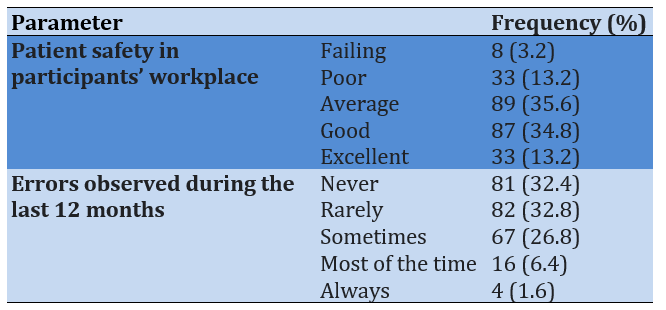
Overall, 35.6% of the participants rated patient safety in their workplace as average. The mean patient safety score was 3.41±0.98. In addition, 32.4% of the participants reported that they had never observed errors in their work units during the previous 12 months. The mean score for the frequency of observed errors was 2.12±0.99 (Table 4).
Table 4. Frequency of patient safety and errors
Discussion
This study investigated the PSC in a general hospital in Khuzestan, Iran. Evaluating the level of PSC is the first step in developing a safety culture within an organization. Moreover, providing safe care without sufficient information about the situation may increase costs and expose the organization to risks [5].
The overall PRR across all dimensions of the HSOPSC revealed that the hospital had a moderate level of patient safety, indicating a need for improvement. This result is consistent with those of studies conducted by Jabarkhil et al. in Afghanistan [11, 21-23], where PSC is also at an average level. Despite differences in the timing, location, and environmental conditions of the studies, similar results are obtained. Given the importance of PSC in the hospital environment, attention to its improvement can provide a foundation for enhancing care services. Improving PSC in hospitals is also a major change that requires modifying employees’ values, beliefs, and behaviors to align with the values of a safety culture, with support from senior managers and leaders [24]. Fostering a hospital safety culture is an important development that requires changing the values, beliefs, and behaviors of the organization’s staff to align with the values of a safety culture [25].
The dimension with the highest PRR was “teamwork within units” (33.9%), whereas the dimension with the lowest PRR was “Staffing” (7.3%). Kapaki and Kyriakos in Greece and Mohi Eldin et al. in Egypt found that “teamwork within units” have a positive influence on promoting PSC [26, 27]. The study by Pourshareiati and Mohammad in Iran, demonstrating the need to continue implementing learning programs and continuously improving safety in hospitals, is consistent with our findings [8]. The results of studies conducted in different countries indicate a high average score in the dimension of “teamwork within units” [28, 29]. Regarding the dimension of “teamwork within units,” employees support one another and work together as a team to address problems [30]. Given the importance of safety and its prioritization in hospital accreditation programs, it is necessary to periodically assess staff members’ PSC and improve its level by addressing weaknesses. Greater emphasis should be placed on teamwork to improve PSC. Alsabri et al. examined the influence of teamwork on PSC in a systematic review. They report that effective teamwork interventions can improve PSC outcomes at Kirkpatrick’s Level Four and improve the health of patients and communities [31].
One of the dimensions important in explaining PSC was “management support for patient safety,” for which the respondents received a high average score. It should be noted that these results are consistent with some studies but inconsistent with others. For example, Mohi Eldin et al. found that management support has a positive effect on patient safety [27].
However, Arshadi Bostanabad et al. [30] in Iran and Kapaki & Kyriakos [26] report no relationship between management support and improvements in PSC. The possible explanation for these differences may be variations in the organizational atmosphere and management behavior. Xie et al. report that greater managerial visibility into PSC can have many implications for patient health. An attitudinal intervention for managers reduces the number of patients who fell out of bed and developed pressure ulcers [32].
A change in managerial perspective leads to the proper alignment of the healthcare system, and a supportive managerial perspective accelerates the development of a safety culture.
The other dimension that was important in explaining PSC was “frequency of events reported,” for which the respondents received a high average score. Mohi Eldin et al. [27] in Egypt, Bodur & Emel in Turkey [33], Arshadi Bostanabad et al. [30], Pourshareiati & Mohammad in Iran [8], and Bari et al. in Pakistan [10] declare a lack of effect of the frequency of incident reporting on the promotion of PSC in the hospitals under study. This issue is very effective in increasing PSC and supporting subsequent planning.
This conclusion depends on the context of the organization. Error reporting may be the result of a strong organizational culture within that organization. In addition, advanced-degree, learning-oriented, and progressive organizations demonstrate ways to solve problems and institutionalize a culture of self-improvement.
The dimension of “handoffs and transitions” was important in explaining PSC, and the respondents received a high average score for this dimension. This finding is consistent with those of Kapaki & Kyriakos [26], but it differed from the results of Pourshareiati & Mohammad [8] in Iran, Jabarkhil et al. [22] in Afghanistan, and Mohebi Far et al. [34]. Transferring patient information from one caregiver or therapist to the next in an accurate and appropriate manner can prevent errors in care and treatment. Therefore, paying attention to this issue can effectively improve PSC [13].
The lowest PRRs were associated with three dimensions: “non-punitive response to errors,” “staffing,” and “handoffs and transitions.” This result is consistent with those of Chen & Li and Pourshareiati & Mohammad [8, 28]. Thus, when a culture of non-punitive responses to errors is stronger, the rate of error reporting also increases. Therefore, it is necessary to improve the safety culture.
Staffing-related issues received a low average score. Consistent with our study, Chen & Li and Pourshareiati & Mohammad found that staffing-related issues are the weakest component. This may be due to staff members’ insufficient skills in providing patient care, which increases the possibility of errors [8, 28]. In addition, the lack of a highly motivated workforce is one of the greatest challenges hospitals face [35].
There was a significant positive correlation between PSC and age and hospital work experience. The studies by Haghighi et al. in hospitals in Tehran [36], Heidari et al. in Arak [37], and Arghami et al. [38] support these findings.
However, the study by Zaroushani et al. in the operating rooms of hospitals in Qazvin reports no significant relationships with age, sex, or level of education [39].
The personal and organizational characteristics of healthcare workers can be directly related to PSC. Age and work experience were the strongest of these characteristics and contributed to PSC. An experienced person has a broader perspective. However, it is the organization’s responsibility to transfer this comprehensive perspective to new employees as quickly as possible. Competency-development courses for individuals with varying levels of professional experience can be helpful in this regard. This topic can be considered one of the main areas of professional development [40].
All hospitals should strive to present themselves as patient-friendly institutions by making progress in patient safety. Improving communication openness and teamwork, as well as paying greater attention to systemic and organizational factors, may help improve patient safety. Moreover, continuously evaluating hospitals in terms of PSC, addressing identified weaknesses, and implementing educational interventions for managers and healthcare professionals may be effective in promoting PSC and patient safety. Holding educational workshops may also help raise healthcare providers’ and managers’ awareness of PSC.
Conclusion
Patient safety culture is below the standard in the studied hospital, and is associated with age, sex, and shift type.
Acknowledgments: We appreciate the Deputy of Research and Technology at Lorestan University of Medical Sciences for approving and supporting this research (IR.LUMS.REC.1398.203). We express our gratitude to all the HCPs who participated in the study.
Ethical Permissions: Ethical approval was obtained from the ethics committee of Lorestan University of Medical Sciences (Code: IR.LUMS.REC.1393.203).
Conflicts of Interests: The authors declared no conflicts of interest.
Authors' Contribution: Merdasi Z (First Author), Main Researcher, and Methodologist (25%); Goudarzi F (Second author), Main Researcher, Methodologist and Discussion Writer (30%); Hasanvand Sh (Third author), Assistant Researcher and introduction writer (15%); Birjandi M (Furth author), Methodologist and Statistical Analyst (15%); Galehdar N (Fifth author), Assistant Researcher and introduction writer (15%).
Funding/Support: This study did not receive any financial support.
Full-Text: (10 Views)
Introduction
Patient safety is a primary component of service quality in health care organizations [1, 2]. Moreover, it is one of the most important indicators of the quality of health care services [3]. Patient safety and quality of care, as two inseparable components, are important indicators related to the competence of health care professionals and patient satisfaction [4]. As a global health challenge, safety culture plays a key role in patient safety [5]. Patient safety culture (PSC) comprises a set of social and professional beliefs, norms, motivations, patterns, and functions that reduce the exposure of employees, managers, clients, and the general public to harmful situations [6]. In a hospital with a favorable safety culture, nurses can freely and promptly express their opinions when an accident might occur because of systemic problems or human factors. However, in hospitals with an unfavorable safety culture, health care providers (HCPs) may be unable to express their opinions freely, which may harm patients in the process [7].
Statistics on the incidence of events related to patient safety problems vary. Studies have revealed that 2.9–16.6% of patients in acute care units experienced at least one harmful incident, while 50% of these cases were preventable [8]. Despite increasing efforts to take the initiative in implementing patient safety programs around the world, patient injury remains the fourteenth leading cause of death [9]. The World Health Organization (WHO) reports that 42.7 million adverse healthcare events occur worldwide each year [10]. According to the WHO, among every 100 hospitalized patients, 7 in developed countries and 10 in developing countries are affected by health care–associated infections. However, 50% of these infections are preventable through simple measures, such as observing hand hygiene and wearing appropriate clothing, hats, and glasses. An appropriate safety culture is needed to address these issues [3].
A strong safety culture promotes patient safety, improves patient treatment outcomes, and enhances the quality of health care services. Conversely, a low and unfavorable level of safety culture in hospitals leads to undesirable consequences for patients and imposes substantial costs on hospitals [9, 11, 12]. The development of a safety culture and increased awareness of concepts related to a safe workplace environment are associated with increased reporting of medical errors and a reduction in harmful events [3, 13].
The development of a safety culture requires consideration of its twelve dimensions: the frequency of events reported, overall perceptions of patient safety, supervisor/manager expectations and actions promoting patient safety, organizational learning/continuous improvement, teamwork across units, communication openness, feedback and communication about errors, a nonpunitive response to errors, staffing, management support for patient safety, teamwork within units, and handoffs and transitions. Different studies have reported varying conditions across these dimensions in different countries [1, 14, 15]. Some studies have focused on a single group of nurses or physicians, while few have examined the health care team as a whole. As investigations of safety culture dimensions have shown, safety culture should be considered at the team level.
Hospital safety culture can be influenced by various factors, such as age, gender, marital status, educational status, type of work shift, work experience, employment status, job position, and average weekly work hours [16, 17]. The effects of these factors vary among different populations and need to be investigated; however, few studies have been conducted in this area. Considering the importance of maintaining patient safety, the lack of studies focusing on teamwork, and the need to examine the factors influencing safety culture, this study was conducted to assess PSC and its predictive factors among HCPs working at a hospital in Iran.
Instrument and Methods
This cross-sectional study was conducted at a hospital in Khuzestan Province, Iran, in 2020.
The research setting included all hospital units, including the emergency department, internal medicine, pediatrics, gynecology, surgery, maternity, hemodialysis, psychiatry, operating room, intensive care unit (ICU), and cardiac care unit (CCU).
Sampling was conducted using the census method. The participants included all 250 HCPs from different job categories, including nurses, the head of the hospital safety committee, the safety committee technician, the clinical supervisor, the educational supervisor, the infection control supervisor, the matron, respiratory therapists/anesthesiologists, a physiotherapist, the person responsible for education, an infection control assistant, a patient safety assistant, servitors, assistant nurses, and a pharmacist.
The inclusion criteria were working as a member of the healthcare team at the time of the study, a work experience of more than 6 months, and willingness to participate in the research. The exclusion criterion was leaving the hospital system for any reason, including leaving the job, resigning, or taking vacation during the data-collection period.
The Hospital Survey on Patient Safety Culture (HSOPSC) was used to collect the data. It was originally developed by the American Agency for Healthcare Research and Quality (AHRQ) in 2004. This 42-item questionnaire measures safety culture across 12 dimensions: supervisor/manager expectations and actions promoting patient safety (4 items), organizational learning/continuous improvement (3 items), teamwork within units (4 items), communication openness (3 items), feedback and communication about errors (3 items), nonpunitive response to errors (3 items), staffing (4 items), management support for patient safety (3 items), teamwork across units (4 items), overall perceptions of patient safety (3 items), handoffs and transitions (4 items), and frequency of events reported (4 items) [18].
The questionnaire includes two items that ask participants to rate patient safety in their workplace (from inappropriate=1 to excellent=5) and to report the frequency of events they reported during the past 12 months. In Iran, Moghri et al. assessed the psychometric properties and validity of the HSOPSC and obtained values of 14.25, 0.96, and 0.98 for the fitness function (FF), goodness-of-fit index (GFI), and adjusted goodness-of-fit index (AGFI), respectively, demonstrating a very good fit. The internal consistency of all items was acceptable, and Cronbach’s alpha coefficient was 0.86. The HSOPSC is a valid scale for assessing PSC in Iran [19].
The positive response rate (PRR) was calculated for each item and dimension. The average positivity rate across all responses to each item was considered the item’s positivity rate. Furthermore, the positivity rate for each dimension was calculated by averaging the positivity rates of all items included in that dimension. Based on the PRR, the 12 dimensions were classified into three levels: strong, requiring improvement, and neutral, corresponding to more than 75%, 50%–75%, and less than 50%, respectively. In addition, the overall level of PSC was defined as weak when it was less than 50%, acceptable when it was 51%-75%, and desirable when it was more than 75% [20]. Additional questions regarding demographic and job characteristics (age, gender, marital status, educational status, type of work shift, work experience, employment status, job position, and average weekly working hours) were added to the HSOPSC to determine their relationship with the participants’ PSC.
Approval to conduct the study was obtained from the hospital manager. Written informed consent was obtained from the participants after they were provided with information about the study’s aims and methods. In addition, they were assured that their data would remain confidential and that their careers and job positions would be protected. To ensure participant anonymity, participants were not required to provide their names on the questionnaire.
To collect the data, the researcher (ZM) visited the units during all shifts (morning, evening, and night) and distributed the questionnaires to the participants. The participants were asked to complete the questionnaires within 24 hours. This process lasted approximately two weeks.
Data were analyzed using SPSS 19. Different inferential analysis methods, including the Pearson correlation coefficient, one-way analysis of variance (ANOVA), exploratory factor analysis, and multiple linear regression, were used to examine the relationships between PSC and its potential predictors.
Findings
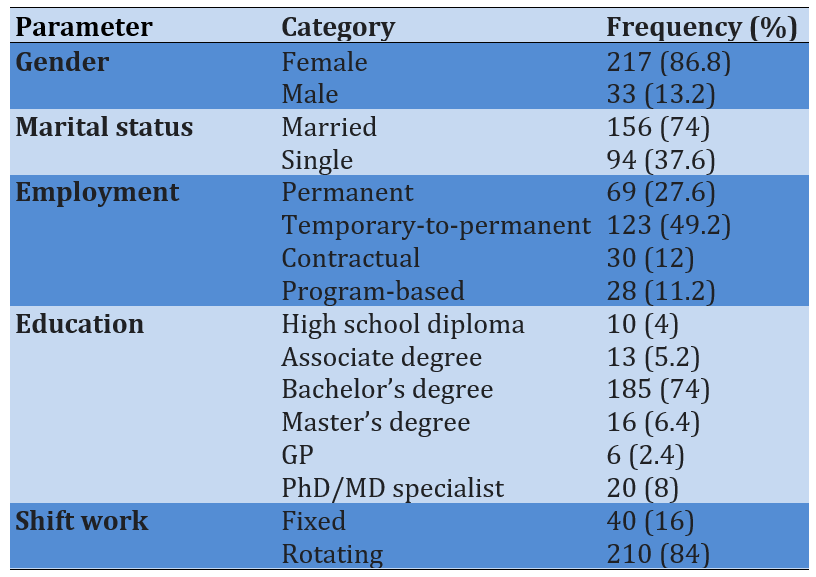
A total of 250 fully completed questionnaires were returned. The mean age of the participants was 34.63±6.25 years (Table 1).
Table 1. Frequency of demographic and professional characteristics of the participants
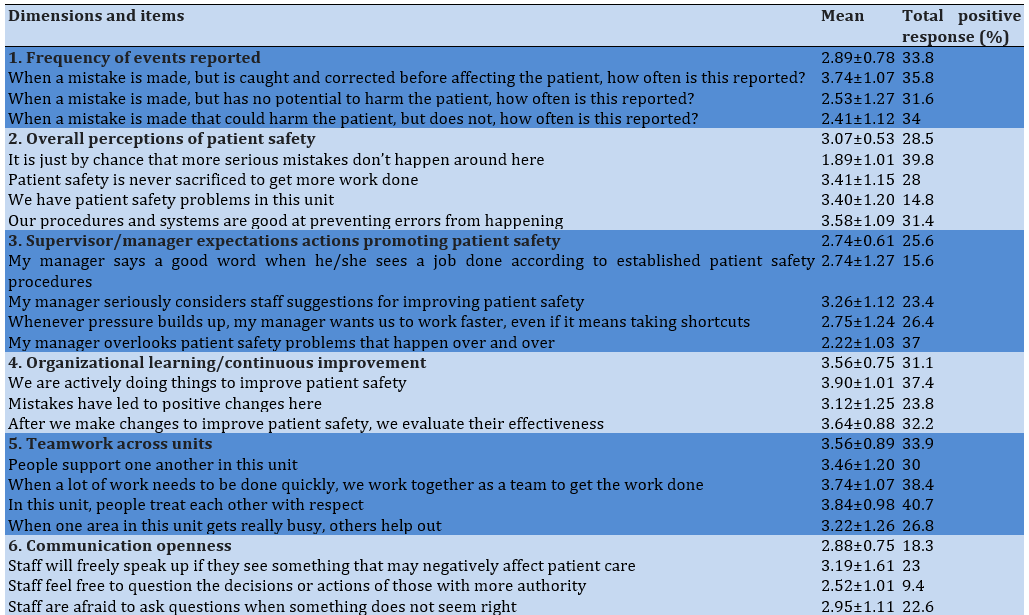
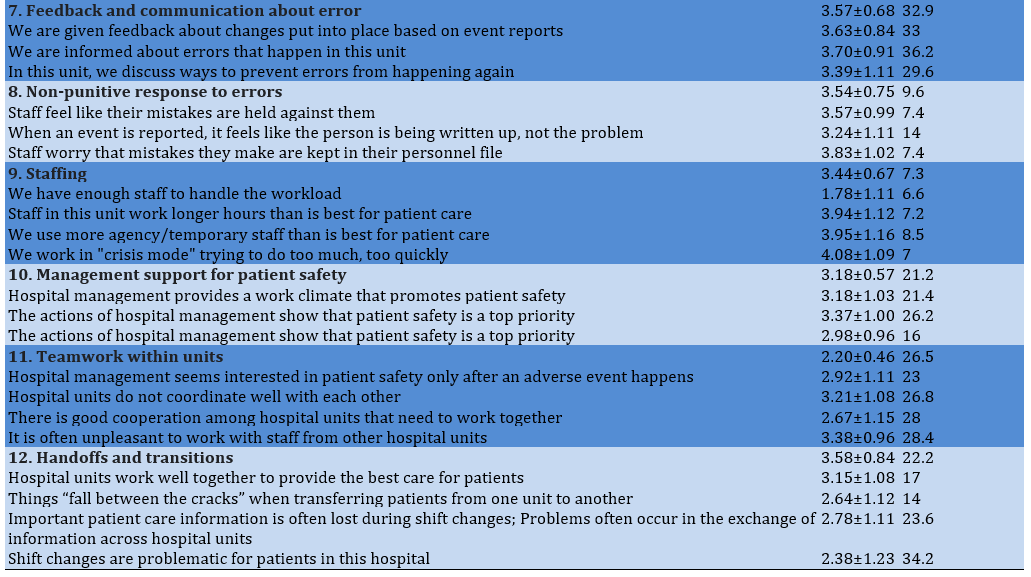
All 12 dimensions of PSC had a positivity rate of less than 50%, indicating that all of them required improvement. In the dimension of “frequency of events reported,” which had a positivity rate of 33.8%, the highest positivity rate was associated with the item “If a mistake is made, is caught, and corrected before affecting the patient” (35.8%; Table 2).
Age (r=0.15; p=0.016) and work experience in the hospital (r=0.18; p=0.005) were positively associated with PSC. Multiple linear regression analysis using the stepwise method, with age, gender, marital status, educational level, work experience, type of shift, and employment status entered as parameters, revealed that gender, age, and type of shift had significant effects on the overall PSC score.
Gender, age, and shift type were significantly associated with the total patient safety culture score. After controlling for the other parameters, male nurses had, on average, a score 5.5 points lower than female nurses (p=0.008). Nurses working rotating shifts also had substantially lower scores than those working fixed shifts, with an adjusted difference of 43.4 points. In addition, the total safety culture score increased by approximately 0.24 points for every one-year increase in age, and this association was statistically significant.
Table 2. The dimensions and items of the patient safety culture based on the Hospital Survey on Patient Safety Culture (HSOPSC)
The factor analysis showed that the data were suitable for analysis, as indicated by the KMO value of 0.833 and the significant Bartlett’s test (p<0.001). Three factors were identified, together explaining approximately 55.5% of the total variance. The first factor, which explained 32.47% of the variance, included general understanding of patient safety, organizational learning, teamwork within units, openness of communication, communication and feedback, and management support. The second factor explained 13.42% of the variance and included nonpunitive responses to errors, staffing issues, and information exchange. The third factor explained 9.65% of the variance and included the frequency of error reporting and teamwork between organizational units.
According to the analysis of factor levels, gender and education significantly influenced Factor 1. Female nurses had 5.2 times higher odds of being classified in a higher factor level than male nurses (p=0.019). Nurses with a bachelor’s degree also had higher odds of being in a higher level than nurses with education beyond a bachelor’s degree (p=0.049). For Factor 2, work experience in a special-care department was the only significant predictor; each additional year of experience increased the odds of being in a higher level by approximately 0.08 (p=0.019). For Factor 3, only employment status had a significant effect. Other examined parameters did not show statistically significant associations with the factor levels.
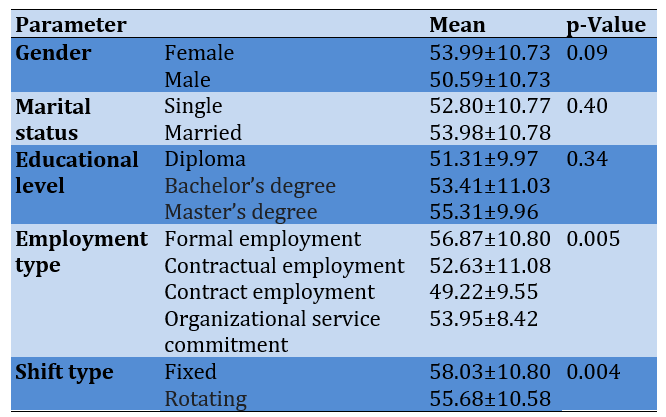
According to the univariate analysis, nurses working fixed shifts had significantly higher patient safety culture scores than those working rotating shifts (p=0.004). Employment type was also significantly associated with patient safety culture scores (p=0.005), with formal employees having the highest mean score. Although female nurses had a higher mean score than male nurses, this difference was not statistically significant (p = 0.09; Table 3).
Table 3. Comparison of the mean scores of patient safety culture based on demographic characteristics
Overall, 35.6% of the participants rated patient safety in their workplace as average. The mean patient safety score was 3.41±0.98. In addition, 32.4% of the participants reported that they had never observed errors in their work units during the previous 12 months. The mean score for the frequency of observed errors was 2.12±0.99 (Table 4).
Table 4. Frequency of patient safety and errors
Discussion
This study investigated the PSC in a general hospital in Khuzestan, Iran. Evaluating the level of PSC is the first step in developing a safety culture within an organization. Moreover, providing safe care without sufficient information about the situation may increase costs and expose the organization to risks [5].
The overall PRR across all dimensions of the HSOPSC revealed that the hospital had a moderate level of patient safety, indicating a need for improvement. This result is consistent with those of studies conducted by Jabarkhil et al. in Afghanistan [11, 21-23], where PSC is also at an average level. Despite differences in the timing, location, and environmental conditions of the studies, similar results are obtained. Given the importance of PSC in the hospital environment, attention to its improvement can provide a foundation for enhancing care services. Improving PSC in hospitals is also a major change that requires modifying employees’ values, beliefs, and behaviors to align with the values of a safety culture, with support from senior managers and leaders [24]. Fostering a hospital safety culture is an important development that requires changing the values, beliefs, and behaviors of the organization’s staff to align with the values of a safety culture [25].
The dimension with the highest PRR was “teamwork within units” (33.9%), whereas the dimension with the lowest PRR was “Staffing” (7.3%). Kapaki and Kyriakos in Greece and Mohi Eldin et al. in Egypt found that “teamwork within units” have a positive influence on promoting PSC [26, 27]. The study by Pourshareiati and Mohammad in Iran, demonstrating the need to continue implementing learning programs and continuously improving safety in hospitals, is consistent with our findings [8]. The results of studies conducted in different countries indicate a high average score in the dimension of “teamwork within units” [28, 29]. Regarding the dimension of “teamwork within units,” employees support one another and work together as a team to address problems [30]. Given the importance of safety and its prioritization in hospital accreditation programs, it is necessary to periodically assess staff members’ PSC and improve its level by addressing weaknesses. Greater emphasis should be placed on teamwork to improve PSC. Alsabri et al. examined the influence of teamwork on PSC in a systematic review. They report that effective teamwork interventions can improve PSC outcomes at Kirkpatrick’s Level Four and improve the health of patients and communities [31].
One of the dimensions important in explaining PSC was “management support for patient safety,” for which the respondents received a high average score. It should be noted that these results are consistent with some studies but inconsistent with others. For example, Mohi Eldin et al. found that management support has a positive effect on patient safety [27].
However, Arshadi Bostanabad et al. [30] in Iran and Kapaki & Kyriakos [26] report no relationship between management support and improvements in PSC. The possible explanation for these differences may be variations in the organizational atmosphere and management behavior. Xie et al. report that greater managerial visibility into PSC can have many implications for patient health. An attitudinal intervention for managers reduces the number of patients who fell out of bed and developed pressure ulcers [32].
A change in managerial perspective leads to the proper alignment of the healthcare system, and a supportive managerial perspective accelerates the development of a safety culture.
The other dimension that was important in explaining PSC was “frequency of events reported,” for which the respondents received a high average score. Mohi Eldin et al. [27] in Egypt, Bodur & Emel in Turkey [33], Arshadi Bostanabad et al. [30], Pourshareiati & Mohammad in Iran [8], and Bari et al. in Pakistan [10] declare a lack of effect of the frequency of incident reporting on the promotion of PSC in the hospitals under study. This issue is very effective in increasing PSC and supporting subsequent planning.
This conclusion depends on the context of the organization. Error reporting may be the result of a strong organizational culture within that organization. In addition, advanced-degree, learning-oriented, and progressive organizations demonstrate ways to solve problems and institutionalize a culture of self-improvement.
The dimension of “handoffs and transitions” was important in explaining PSC, and the respondents received a high average score for this dimension. This finding is consistent with those of Kapaki & Kyriakos [26], but it differed from the results of Pourshareiati & Mohammad [8] in Iran, Jabarkhil et al. [22] in Afghanistan, and Mohebi Far et al. [34]. Transferring patient information from one caregiver or therapist to the next in an accurate and appropriate manner can prevent errors in care and treatment. Therefore, paying attention to this issue can effectively improve PSC [13].
The lowest PRRs were associated with three dimensions: “non-punitive response to errors,” “staffing,” and “handoffs and transitions.” This result is consistent with those of Chen & Li and Pourshareiati & Mohammad [8, 28]. Thus, when a culture of non-punitive responses to errors is stronger, the rate of error reporting also increases. Therefore, it is necessary to improve the safety culture.
Staffing-related issues received a low average score. Consistent with our study, Chen & Li and Pourshareiati & Mohammad found that staffing-related issues are the weakest component. This may be due to staff members’ insufficient skills in providing patient care, which increases the possibility of errors [8, 28]. In addition, the lack of a highly motivated workforce is one of the greatest challenges hospitals face [35].
There was a significant positive correlation between PSC and age and hospital work experience. The studies by Haghighi et al. in hospitals in Tehran [36], Heidari et al. in Arak [37], and Arghami et al. [38] support these findings.
However, the study by Zaroushani et al. in the operating rooms of hospitals in Qazvin reports no significant relationships with age, sex, or level of education [39].
The personal and organizational characteristics of healthcare workers can be directly related to PSC. Age and work experience were the strongest of these characteristics and contributed to PSC. An experienced person has a broader perspective. However, it is the organization’s responsibility to transfer this comprehensive perspective to new employees as quickly as possible. Competency-development courses for individuals with varying levels of professional experience can be helpful in this regard. This topic can be considered one of the main areas of professional development [40].
All hospitals should strive to present themselves as patient-friendly institutions by making progress in patient safety. Improving communication openness and teamwork, as well as paying greater attention to systemic and organizational factors, may help improve patient safety. Moreover, continuously evaluating hospitals in terms of PSC, addressing identified weaknesses, and implementing educational interventions for managers and healthcare professionals may be effective in promoting PSC and patient safety. Holding educational workshops may also help raise healthcare providers’ and managers’ awareness of PSC.
Conclusion
Patient safety culture is below the standard in the studied hospital, and is associated with age, sex, and shift type.
Acknowledgments: We appreciate the Deputy of Research and Technology at Lorestan University of Medical Sciences for approving and supporting this research (IR.LUMS.REC.1398.203). We express our gratitude to all the HCPs who participated in the study.
Ethical Permissions: Ethical approval was obtained from the ethics committee of Lorestan University of Medical Sciences (Code: IR.LUMS.REC.1393.203).
Conflicts of Interests: The authors declared no conflicts of interest.
Authors' Contribution: Merdasi Z (First Author), Main Researcher, and Methodologist (25%); Goudarzi F (Second author), Main Researcher, Methodologist and Discussion Writer (30%); Hasanvand Sh (Third author), Assistant Researcher and introduction writer (15%); Birjandi M (Furth author), Methodologist and Statistical Analyst (15%); Galehdar N (Fifth author), Assistant Researcher and introduction writer (15%).
Funding/Support: This study did not receive any financial support.
References
1. Pilarska A, Zimmermann A, Pia˛tkowska K, Tomasz J. Patient safety culture in EU legislation. Healthcare. 2020;8(4):410. [Link] [DOI:10.3390/healthcare8040410]
2. Kang S, Ho TTT, Lee NJ. Comparative studies on patient safety culture to strengthen health systems among Southeast Asian countries. Front Public Health. 2021;8:600216. [Link] [DOI:10.3389/fpubh.2020.600216]
3. Vikan M, Haugen AS, Bjørnnes AK, Valeberg BT, Deilkås ECT, Danielsen SO. The association between patient safety culture and adverse events-a scoping review. BMC Health Serv Res. 2023;23(1):300. [Link] [DOI:10.1186/s12913-023-09332-8]
4. Al-Jabri F, Kvist T, Sund R, Hannele T. Quality of care and patient safety at healthcare institutions in Oman: Quantitative study of the perspectives of patients and healthcare professionals. BMC Health Serv Res. 2021;21:1109. [Link] [DOI:10.1186/s12913-021-07152-2]
5. Reis CT, Paiva SG, Paulo S. The patient safety culture: A systematic review by characteristics of hospital survey on patient safety culture dimensions. Int J Qual Health Care. 2018;30(9):660-77. [Link] [DOI:10.1093/intqhc/mzy080]
6. Lawati MHA, Dennis S, Short SD, Abdulhadi NN. Patient safety and safety culture in primary health care: A systematic review. BMC Fam Pract. 2018;19(1):104. [Link] [DOI:10.1186/s12875-018-0793-7]
7. Chegini Z, Kakemam E, Asghari Jafarabadi M, Janati A. The impact of patient safety culture and the leader coaching behaviour of nurses on the intention to report errors: A cross-sectional survey. BMC Nurs. 2020;19:89. [Link] [DOI:10.1186/s12912-020-00472-4]
8. Pourshareiati F, Mohammad A. Patient safety culture from Rahnemon hospital nurses' perspective. Occup Hyg Health Promot J. 2017;1(1):52-61. [Persian] [Link]
9. Albalawi A, Kidd L, Eileen C. Factors contributing to the patient safety culture in Saudi Arabia: A systematic review. BMJ Open. 2020;10(10):e037875. [Link] [DOI:10.1136/bmjopen-2020-037875]
10. Bari A, Khan RA, Rathore AW. Medical errors; Causes, consequences, emotional response and resulting behavioral change. Pak J Med Sci. 2016;32(3):523-8. [Link] [DOI:10.12669/pjms.323.9701]
11. Kumbi M, Hussen A, Lette A, Nuriye Sh, Morka G. Patient safety culture and associated factors among health care providers in Bale Zone Hospitals, Southeast Ethiopia: An institutional based cross-sectional study. Drug Healthc Patient Saf. 2020;12:1-14. [Link] [DOI:10.2147/DHPS.S198146]
12. Ulrich B, Tamara K. Patient safety and patient safety culture: Foundations of excellent health care delivery. Nephrol Nurs J. 2014;41(5):447-56. [Link]
13. Mardon RE, Khanna K, Sorra J, Dyer N, Theresa F. Exploring relationships between hospital patient safety culture and adverse events. J Patient Saf. 2010;6(4):226-32. [Link] [DOI:10.1097/PTS.0b013e3181fd1a00]
14. Davati A, Vatankhah S, Sharifi K. Assessment of patient safety culture at Shahid Mostafa Khomeini Hospital: Nurses' perspective. J Health Adm. 2018;20(70):10-21. [Persian] [Link]
15. Kuosmanen A, Tiihonen J, Repo-Tiihonen E, Eronen M, Hannele T. Changes in patient safety culture: A patient safety intervention for Finnish forensic psychiatric hospital staff. J Nurs Manag. 2019;27(4):848-57. [Link] [DOI:10.1111/jonm.12760]
16. Asgarian A, Sadeghi R, Abolhasani F, Mohammadbeigi A, Omidi Oskouei A, Soltanzadeh A. Association between job satisfaction, burnout, and patient safety culture among medical staff of the Qom University of Medical Sciences in 2020, Iran. J Occup Health Epidemiol. 2021;10(2):127-33. [Link] [DOI:10.52547/johe.10.2.127]
17. Naji Gehad MA, Isha Ahmad SN, Alazzani A, Saleem Muhammad Sh, Alzoraiki M. Assessing the mediating role of safety communication between safety culture and employees safety performance. Front Public Health. 2022;10:840281. [Link] [DOI:10.3389/fpubh.2022.840281]
18. Ebadi Fard Azar F, Rezapoor A, Tanoomand Khoushehmehr A, Bayat R, Arabloo J, Rezapoor Z. Study of patients'safety culture in Selected Training hospitals affiliated whith Tehran University of Medical Sciences. Hospital. 2012;11(2):55-64. [Persian] [Link]
19. Moghri J, Ghanbarnezhad A, Moghri M, Rahimi Forooshani A, Akbari Sari A, Rezapoor M. Validation of Farsi version of hospital survey on patient safety culture questionnaire, using confirmatory factor analysis method. Hospital. 2012;11(2):19-30. [Persian] [Link]
20. Andel C, Davidow SL, Hollander M, Moreno DA. The economics of health care quality and medical errors. J Health Care Finance. 2012;39(1):39-50. [Link]
21. Farzi S, Moladoost A, Bahrami M, Farzi S, Etminani R. Patient safety culture in intensive care units from the perspective of nurses: A cross-sectional study. Iran J Nurs Midwifery Res. 2017;22(5):372-6. [Link] [DOI:10.4103/ijnmr.IJNMR_150_16]
22. Jabarkhil AQ, Tabatabaee SS, Jamali J, Moghri J. Assessment of patient safety culture among doctors, nurses, and midwives in a public hospital in Afghanistan. Risk Manag Healthc Policy. 2021;14:1211-7. [Link] [DOI:10.2147/RMHP.S292193]
23. Mekonnen AB, McLachlan AJ, Brien JE, Desalew M, Zenahebezu A. Hospital survey on patient safety culture in Ethiopian public hospitals: A cross-sectional study. Saf Health. 2017;3(11):11. [Link] [DOI:10.1186/s40886-017-0062-9]
24. McFadden KL, Stock GN, Gowen CR. Leadership, safety climate, and continuous quality improvement: Impact on process quality and patient safety. Health Care Manag Rev. 2015;40(1):24-34. [Link] [DOI:10.1097/HMR.0000000000000006]
25. Khoshakhlagh AH, Khatooni E, Akbarzadeh I, Yazdanirad S, Sheidaei A. Analysis of affecting factors on patient safety culture in public and private hospitals in Iran. BMC Health Serv Res. 2019;19(1):1009. [Link] [DOI:10.1186/s12913-019-4863-x]
26. Kapaki V, Kyriakos S. Psychometric Properties of the Hospital Survey on Patient Safety Culture (HSOPSC): Findings from Greece. In: Vignettes in patient safety (Volume 2). London: IntechOpen Limited; 2017. [Link] [DOI:10.5772/intechopen.69997]
27. Mohi Eldin MM, Eissa EM, Elmorsy HM. Safety and efficacy of mini open transforaminal lumbar interbody fusion. Korean J Spine. 2016;13(4):190-5. [Link] [DOI:10.14245/kjs.2016.13.4.190]
28. Chen IC, Li HH. Measuring patient safety culture in Taiwan using the Hospital Survey on Patient Safety Culture (HSOPSC). BMC Health Serv Res. 2010;10:152. [Link] [DOI:10.1186/1472-6963-10-152]
29. El-Jardali F, Jaafar M, Dimassi H, Jamal D, Rana H. The current state of patient safety culture in Lebanese hospitals: A study at baseline. Int J Qual Health Care. 2010;22(5):386-95. [Link] [DOI:10.1093/intqhc/mzq047]
30. Arshadi Bostanabad M, Jebreili M, Kargari RM. Assessment of nursing safe performance in neonatal intensive care units of Tabriz. J Pediatr Nurs. 2015;1(2):49-60. [Persian] [Link]
31. Alsabri M, Boudi Z, Lauque D, Dias RD, Whelan JS, Östlundh L, et al. Impact of teamwork and communication training interventions on safety culture and patient safety in emergency departments: A systematic review. J Patient Saf. 2022;18(1):e351-61. [Link] [DOI:10.1097/PTS.0000000000000782]
32. Xie JF, Ding SQ, Zhong ZQ, Zeng SN, Qin CX, Yi QF, et al. A safety culture training program enhanced the perceptions of patient safety culture of nurse managers. Nurse Educ Pract. 2017;27:128-33. [Link] [DOI:10.1016/j.nepr.2017.08.003]
33. Bodur S, Emel F. Validity and reliability of Turkish version of "Hospital Survey on Patient Safety Culture" and perception of patient safety in public hospitals in Turkey. BMC Health Serv Res. 2010;10:28. [Link] [DOI:10.1186/1472-6963-10-28]
34. Mohebi Far R, Alijan Zade M, Safari Variani A, Khoshtarkib H, Ghanati E, Teymouri F, et al. Studying patient safety culture from the viewpoint of staff in educational hospitals in Tehran City. J Health Saf Work. 2015;5(1):57-64. [Persian] [Link]
35. Håvold OKS, Håvold JI, Glavee-Geo R. Trust in leaders, work satisfaction and work engagement in public hospitals. Int J Public Leadersh. 2021;17(2):145-59. [Link] [DOI:10.1108/IJPL-07-2020-0061]
36. Haghighi M, Zinat Motlagh K, Zinat Motlagh F, Taghdisi MH. Assessment of patient safety culture among employees of healthcare providers' hospitals in Tehran. J Health Syst Res. 2015;10(1):49-57. [Persian] [Link]
37. Heidari MH, Farshad AA, Arghami Sh. A study on relationship between production link worker's safety attitude and their safe act in of Arak metal industry. Iran Occup Health. 2007;4(3 & 4):1-9. [Persian] [Link]
38. Arghami S, Pouya Kian M, Mohammadfam I. Effects of safety signs on the modification of unsafe behaviours. J Adv Med Biomed Res. 2009;17(68):93-8. [Link]
39. Zaroushani V, Sheykhi S, Amini M, Mohammadi Zeydi E. Investigation of safety attitude among operating room staff of educational hospital of Qazvin University of Medical Sciences. Proceedings of the 2nd Conference in Tehran Safe Community. Tehran: Mashhad Municipality; 2009. p. 226-33. [Persian] [Link]
40. Khademi E, Abdi M, Saeidi M, Piri Sh, Mohammadian R. Emotional intelligence and quality of nursing care: A need for continuous professional development. Iran J Nurs Midwifery Res. 2021;26(4):361-7. [Link] [DOI:10.4103/ijnmr.IJNMR_268_19]